The Challenges of Boris Johnson’s 2025 Full Fibre for All UK Pledge

The new Prime Minister for the United Kingdom, Boris Johnson, recently confirmed his ambition to deliver “full fibre” ultrafast broadband nationwide by 2025 but many, ourselves included, have wondered aloud whether or not that’s even possible. We take a closer look.
The previous administration pledged to deliver Gigabit capable Fibre-to-the-Premises (FTTP) broadband ISP connections to 10 million UK premises by 2022, then 15 million by 2025 and they also held an aspiration for “nationwide” coverage by 2033 (here). All of this was underpinned by various regulatory and policy changes (Future Telecoms Infrastructure Review), business rates relief and several investment / voucher schemes.
At this point those familiar with the reality of deploying fibre optic cables down every single street and lane in a country, especially one dotted with masses of individual houses, will know that the previous 2033 date was already quite optimistic. Other countries have been deploying FTTP at scale for a decade or more and even for them the final 30-40% of premises is expected to be several times slower and more expensive to reach.
Advertisement
Despite this Boris Johnson called the 2033 aspiration “laughably unambitious” and said that he could “unite our country” by delivering “full fibre for all … in five years at the outside” (here). Top marks for the bold and most welcome aspiration but what’s less clear is how this is going to become possible. Grade F for the lack of detail and any sign of committed funding.
Boris Johnson, Prime Minister, said (Victory Speech):
“And we are once again going to believe in ourselves and what we can achieve. And like some slumbering giant, we are going to rise and ping off the guy ropes of self-doubt and negativity with better education, better infrastructure, more police, fantastic full-fibre broadband sprouting in every household.
We are going to unite this amazing country and we are going to take it forward. I thank you all very much for the incredible honour that you’ve just done me. I will work flat out from now on with my team that I will build.”
The challenge now is how the Prime Minister will deliver on such a commitment, particularly as we’re not aware of any other country in the world – except maybe for the odd city-state with very different considerations to the UK – where it has been possible to achieve the sort of deployment pace that would be required.
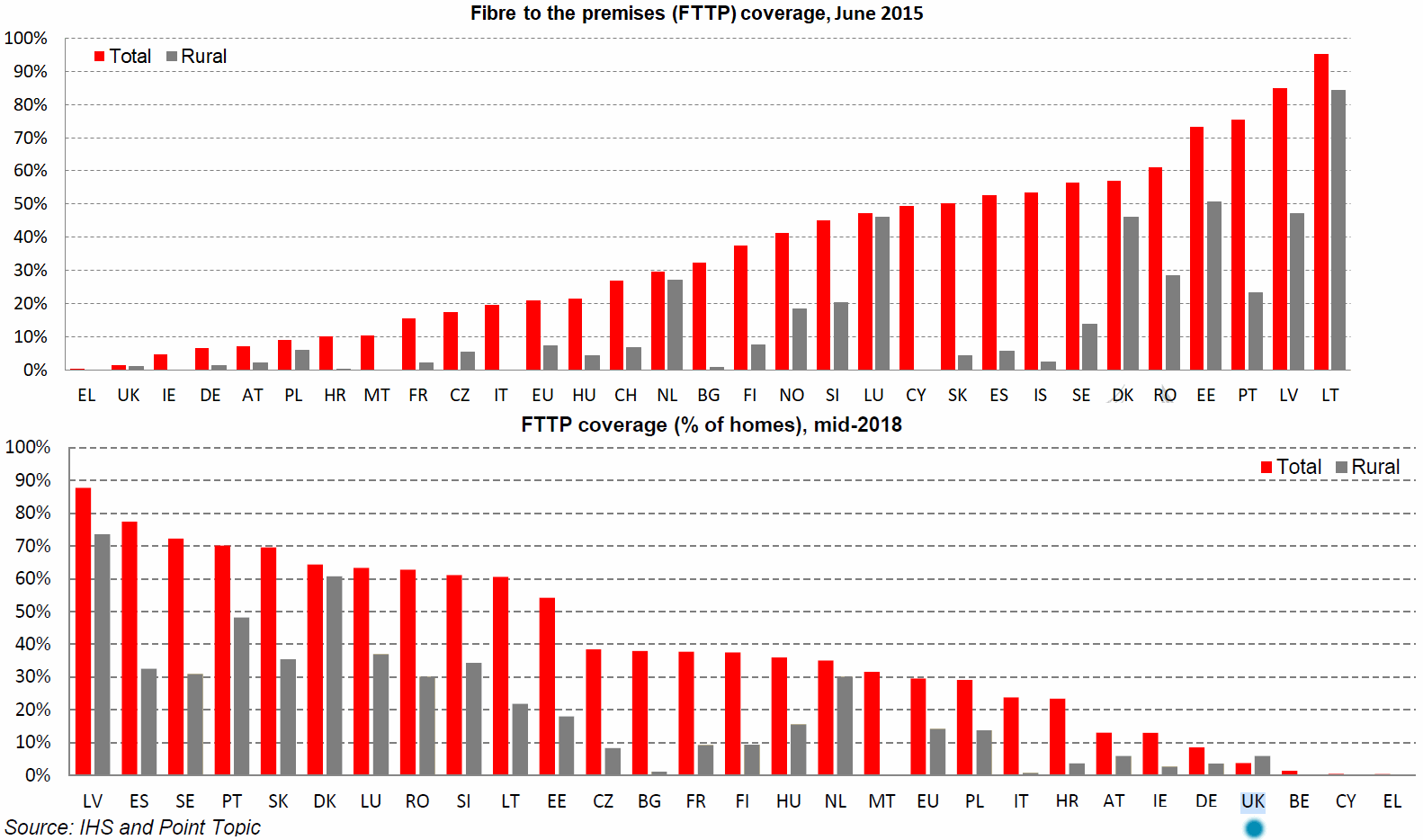
Some counties, such as Spain, have done better than others but that’s because most of their people live in apartments (c.66%), which are significantly cheaper to connect (here). By comparison most UK people live in individual housing (only about 15% in apartments), which is a much slower and more costly market to tackle. Apartment living is fairly common across the EU (42% average), except in Ireland, the UK and a few other states.
The above also includes some countries that have benefited from significantly more public funding than the UK and, sometimes, play host to a less competitive market. The latter is often seen as a positive for FTTP since it makes the investment return more dependable, rather than in an aggressively competitive market – like ours – where prices are driven down (i.e. the investment case gets harder).
Advertisement
Just take a look at the 2015 vs 2018 change below to see how much progress is being made across 3 years and remember, nearly all of this comes from the relatively easy and quick urban bits. Even in Sweden (SE), which has been at the FTTH game since 2006, they’re still several years away from 100% coverage and that final 30-40% has really slowed the deployment pace.
Key Challenges
At present around 2 million premises (7%+) can already access FTTP and that still leaves around 28 million left to tackle, which when taking in policy delays means we probably need to be building at a rate of around 5 million premises per year (the previous 2033 target required c.2 million+) from start to finish.
Flip over to page 2 to continue our summary of the challenges, deployment costs and feedback.
Advertisement






Mark is a professional technology writer, IT consultant and computer engineer from Dorset (England), he also founded ISPreview in 1999 and enjoys analysing the latest telecoms and broadband developments. Find me on X (Twitter), Mastodon, Facebook, BlueSky, Threads.net and Linkedin.











« ISP BT Sees 40% Increase in Internet Traffic from Fortnite Season 10












Comments are closed