BT Set to Move G.Fast UK Broadband Customers to SOGEA Platform
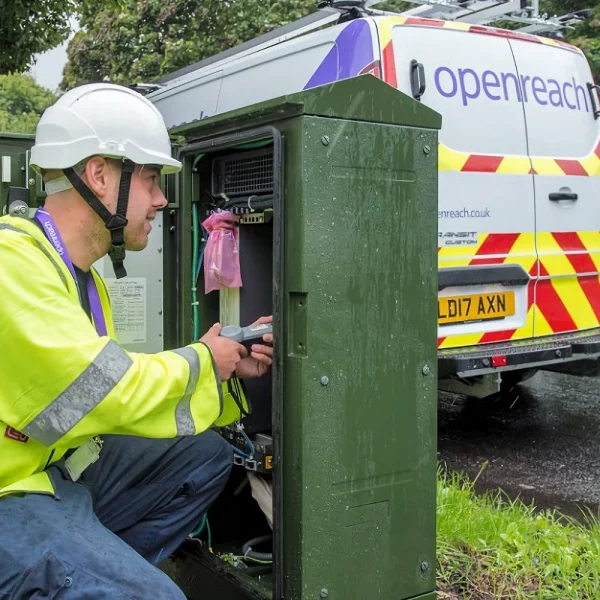
Credible sources have informed ISPreview that UK ISP BT (EE) are preparing to migrate their remaining base of over 20,000 customers on Openreach’s hybrid fibre G.fast “ultrafast broadband” network to the equivalent digital SOGEA (formerly SOGFAST) platform. The change is due to the looming closure of the old analogue phone network (PSTN / WLR).
G.fast (ITU G.9701) was an interim hybrid-fibre and copper technology (like a super version of FTTC), which was capable of speeds up to 330Mbps, but which ultimately ended up being abandoned (here) in favour of Openreach’s welcome desire to build full fibre (FTTP) networks at scale. The service covered c. 2.8 million UK premises at its peak, but much of it has since been overbuilt / replaced by full fibre.
However, a relatively small portion of consumers still have live G.fast connections, which is problematic in the areas where Openreach’s full fibre lines have yet to reach. Such lines were often sold as part of a BT package that also bundled a traditional phone line service, which means they will be impacted when the legacy phone services are switched-off on 31st January 2027.
Advertisement
In short, BT needs to migrate these retail customers to their equivalent G.fast based data-only Single Order Generic Ethernet Access (SOGEA) platform (aka – SoGFast / Single Order G.fast). According to ISPreview’s sources, the ISP still has over 20,000 customers in this boat. We should point out that a few other ISPs have taken a different approach, in some cases forcing users without access to an FTTP alternative to downgrade to slower FTTC (VDSL2) lines.
The good news, as we understand it, is that this won’t have a negative impact on their broadband speeds and customers will not be held to contract lengths. Our sources state that BT will also provide customers with their premium Halo 3 add-on (i.e. enhanced support, the ‘Keep Connected Promise’ with 4G backup, a price promise and WiFi guarantee etc.) and Unlimited Anytime Calls at no extra cost (those who already have Halo 3 will get Halo 3+ instead).
Customers may alternatively be able to leave, penalty free, if they so choose (just make sure you can get something better than G.fast first as most ISPs no longer sell it). BT has since confirmed to ISPreview that G.fast migrations to SOGEA are part of their industry-wide shift away from the ageing PSTN network (where FTTP is not yet available in their area), but they didn’t provide any specific details.






Mark is a professional technology writer, IT consultant and computer engineer from Dorset (England), he also founded ISPreview in 1999 and enjoys analysing the latest telecoms and broadband developments. Find me on X (Twitter), Mastodon, Facebook, BlueSky, Threads.net and Linkedin.











« Giacom Founder and Oakley Capital Consider £1bn UK Takeover of Gamma UPDATE
Advertisement
Leave a Reply
Privacy Notice: Please note that news comments are anonymous, which means that we do NOT require you to enter any real personal details to post a message and display names can be almost anything you like (provided they do not contain offensive language or impersonate a real person's legal name). By clicking to submit a post you agree to storing your entries for comment content, display name, IP and email in our database, for as long as the post remains live.
Only the submitted name and comment will be displayed in public, while the rest will be kept private (we will never share this outside of ISPreview, regardless of whether the data is real or fake). This comment system uses submitted IP, email and website address data to spot abuse and spammers. All data is transferred via an encrypted (https secure) session.














The fastest at my old flat was G.fast and building management refused CityFibre to install FTTP, so either I had to continue paying high prices with Sky or downgrade. And once you downgrade you can’t get G.fast again. Glad I’m now in a place with FTTP.
It truly baffles me when I hear stories of landlords or building management firms refusing to allow the installation of FTTP when it’s been proven that high speed connectivity is a large factor in most people deciding their future homes.
Whilst demand for housing remains high across most of the country, there will always be someone willing to compromise connectivity for somewhere to live.
@AAA maybe it’s a mixture of risk assessments (having to be able to state their building is/isn’t/maybe asbestos free) and not wanting each overbuilding network to be drilling new holes through their walls.
A lot to be said for either single drop lines to buildings back to passive optical patch panels somewhere on the street allowing premises to be connected to any particular AltNet, or at least an agreed standard for internal building distribution. say CAT6 to each apartment and then one cupboard with all the incommers and ONTs or some form of CBTs from each AltNet in the cupboard with fibres to each apartment with their own ONT.
@AAA, I had to get permission and get my provider to send photos to my landlord of where things was going to go. There is a block of Maisonettes just around the corner from me, owned by the same landlord, someone wanted to have FTTP installed and they refused. That was a couple of years agao.
Now it seems things have changed, and no permission is needed. Maybe they realise that FTTP is the thing now.
I agree with you,
@just a thought
most of the time it isn’t risk assessments. in my case it was purely vanity. aka didn’t want holes and wires. after backing them into a corner they pretty much admitted as much. the straw that broke the camels back for me was when BT skyrocketed g.fast prices that were silly and would not budge, I tried to re-order it cheaper but couldn’t so ended up on SOGEA and it was awful.
thankfully new legislation will make getting fibre alot easier.
I’m on a G.Fast connection with IDNet and I’m getting booted off it, they won’t migrate me to the SOGEA equivalent (SoGFast). Only offering me a downgrade to regular 80/20 FTTC as FTTP isn’t available. They are blaming Zen, their wholesaler, for refusing to offer migrations.
Seems poor form to pay a premium to support a smaller ISP for years and to just get the boot where I could have been with a larger player, i.e BT, who seemingly would have migrated me.
I seem to recall that in one of the Zen videos on YouTube a while back they were not planning on supporting SOGFAST or SOADSL as the customer numbers were so low as to make the systems integration work uneconomic.
It would be interesting to know how many active G.Fast connections there are from other ISPs in addition to the 20k BT Retail ones.
How frustrating. You try your best then it’s taken out of your hands.
Yes. Very disappointing that providers who attract less techy customers by offering ‘premium rate’ customer support are abandoning GFast customers.
They don’t seem to want to sell new SOGFAST in areas that can’t get FTTP yet, though. A friend is “stuck” on SOGEA due to this. BT Wholesale says yes, BT retail says no – up to 80Mbit only. This was before the recent brand relaunch so it is not because the BT Smart Hub 3 can’t do G.fast.
I get it’s an EOL technology, and it will probably disappear before VDSL does, but you’d think they’d be happy to make a bit of money off of it in the meantime.
Good, G.fast should never have existed.
If it was rolled out as designed it may have been ok, it was supposed to be deployed from the pole closer to the home combined with some extra fibre deployment, but Openreach tried to do it on the cheap from existing VDSL cabinets. Which as expected was a disaster with such few users benefiting from it.
Tell that to people living in a DiG area.
In theory fibre to the pole then g.fast from pole to the house had one big advantage. The upgrade could be done without an engineer needing to visit the house.
Also once fibre is at the pole, it opens up upgrades to fibre to the home.
I think it was CBTs and ready made fibre (so no splicing up a pole) to the home the way to go, as if you got as far as getting fibre to the pole why not finish the job.
The biggest downfall with fibre to the pole was power. How do you power active electronics on a pole safely and reliably
I can’t remember any actual customers on GFast services posting complaints about the service. So claiming GFast was a ‘disaster’ is likely to be stretching things.
Credit to those providers such as BT and EE who are supporting GFast customers and no credit to those high price providers who are not.
@Martin I seem to remember there was talk that the electronics up the pole could be back powered from the equipment in users homes similar to power over ethernet.
Nor should have FTTC, should have gone straight to FTTP. But this is the U.K behind on stuff.
I suppose in one way it was a good thing, if we had FTTP right away I would have been on Openreach FTTP network and would no doubt have stayed because of not being bothered to move. Also maybe other networks may not have jumped in.
Martin – you could do “reverse power”. This was deployed by the Australian NBN where customers would power a VDSL “micronode” in the street that handled up to four lines. This is done with a specially designed modem.
I think it’s telling that this is the only real commercial deployment of that technology, and it exists primarily for political reasons (NBN is government owned and a change of government led to the intent of a mostly FTTP network turning into “anything but fibre”)
A different operator in Australia uses G.fast micronodes but they are conventionally powered. They already had an FTTdp network dating from the late 90s so this was a relatively cheap and quick upgrade with fibre and power already in place, and the performance is generally very good with gigabit being offered as the top tier.
@Ad47uk – hard disagree with FTTC.
That made a lot of sense at the time. Yes, we should have gone FTTP from the beginning but we can thank the Tories in the late 80’s for that.
The government stifled the early FTTP build by forcing the rapid coverage of super fast broadband which could only realistically be delivered by FTTC. Gfast was a natural evolution of that programme. By the time superfast was complete , capacity was released back to building FTTP, by which time the government had moved the goalposts again .
BT are downgrading the remaining PSTN/G.fast customers to SOGEA vdsl 80/20 profiles with Digital voice.
They won’t be moving any customers to SoGFast.
Generally Openreach use the general “SOGEA” term for service rentals on both G.fast and FTTC/VDSL2 lines now, up to 330Mbps. I’ve mentioned SoGFAST above more for historic familiarity purposes.
But so far neither BT nor our sources have said G.fast customers on the old 160Mbps or 330Mbps profiles will be put on 80/20 FTTC, although some ISPs with different networks are doing that for their own economic reasons. We’ve been told there will be no speed changes for BT’s own Consumers.
I’m currently on Zen G.Fast 330/50 and work from home, we’re not getting fibre until earliest July 2026 but more likely to be later as OpenReach keep putting the dates back.
Because of OR allowing our pole to deteriorate it meant that we couldn’t get 2Gbps from an altnet as they bypassed our pole and it has only taken OR to replace it in February 2026.
Hoping I’m not kicked to slower speeds while waiting to switch to FFTP
I’m also on that same package (since 2019), and when I emailed Zen about it over 2 years ago, they were clear they wouldn’t migrate me on their side.
Since then; Openreach have been “building in my area in the next year” for the past 2 years; CityFibre finally went live after years of delay, but not on my street, and have been ignoring my wayleave request for over 6 months now; Virgin completed a full XGS-PON rollout and are live at my address.
This basically leaves me with 3 options; accept a downgrade to VDSL; hope that CityFibre or Openreach pull their finger out, potentially ending up with no internet at all; make a deal with the devil and sign up for Virgin.
At one point I had the 4th option of finding an ISP that still offered g.fast, but the Openreach checker no longer shows it as an option for me.
It’s such a mess for those of us on g.fast who are still waiting for FTTP. I wish Openreach had just forced the migration on their side, but I guess the ISP has to be involved somehow.
It’s a shame for those on it (G.Fast) as it was great for most of those who wanted faster speeds but not really a surprise considering how far along the FTTP rollout is going.
I agree G-Fast should not have existed,
it should of been Full Fibre instead
CAT6 is now CAT8
“CAT6 is now CAT8” ??
CAT8 is an obsolete standard, intended to do 40Gbps over 4 pairs in data centre environments, for short inter-rack connections up to 30 metres. But nobody built any equipment that uses it.
Anybody who does 40G in a data centre does it over fibre (or for very short distances, Direct Attach Cables)
And anybody who buys CAT8 instead of CAT6 or CAT6A is wasting their money.
It is worse than wasting your money. As Cat8 is now a bundle of minature twinax rather than balanced pairs unless it is used in combination with the special Cg45 connectors and sockets (which it wont be) then you will get a whole bunch of reflections and performance is worse than Cat6a. Most fools using it are of course using it over relatively short distances so get away with it. If they were to get a 60m path lead and try and put 10Gbps over it they would be lucky to even get link.
‘Have’ not ‘of’.
What a bizarre comment.
I am glad on Full Fibre paying 900/110 for £36.99 a month compared to SoGfast (G.fast) 330/50 £56.99! Massive reduced price but massive jump to higher speed.
SoGfast and G.fast should be abolish and replaced with Full Fibre.